American Bone Health has closed. However, on October 1, 2023, we joined forces with the Bone Health and Osteoporosis Foundation (BHOF) so that BHOF could continue offering all of the important programs and services created by American Bone Health. Please visit www.bonehealthandosteoporosis.
Osteoporosis literally means “porous bones.” This occurs for several reasons. About 62% of your bone density is a result of genetics — you may never have had dense bones. Look to your parents for hints. If you did not build bone sufficiently during your bone building years, you are at a lower threshold when you age. With the falling levels of estrogen (in women) and testosterone (in men) and its associated bone loss, you may have bone density below a normal level. Inadequate intake of calcium and vitamin D as a child or as an adult or both will lead to osteoporosis. Some medications, although necessary, will cause bone loss.
Osteopenia or low bone mass is a status classification used to describe bones that are thinner than normal, but have not yet reached the osteoporosis stage. We are now beginning to refer to osteopenia as low bone mass since osteopenia suggests that you have lost bone density. It is possible that you never built bone that was any stronger. If you are older with a bone density in this range, your doctor may consider a bone medication to prevent fractures.
Osteopenia and osteoporosis are on the same spectrum of bone thinning. The bones become more porous and can be at increased risk for fracture.
The classification of low bone density and osteoporosis was standardized against peak bone mass. Adults typically reach peak bone mass around age 30. The scientists used large databases of test results to determine the average for normal peak bone mass, and then the range for low bone mass (osteopenia) and very low bone mass (osteoporosis).
In 1994, the World Health Organization (WHO) reviewed the worldwide data on bone density testing and fracture risk. Prior to this publication, many bone density testing centers reported results by comparing a patient to other patients of the same age. The WHO concluded that, based on studies of older women, reporting the relation of the bone mineral density (BMD) to the average peak bone mineral density of a 30-year old would be more appropriate.
It’s a good idea to always ask what the doctor means. Sometimes they may be looking at your bone density test results and comparing them to others your own age and gender. This is called a Z-score. It’s an adequate comparison, but it’s much better to know how you compare to a 30-year-old normal bone — the T-score.
Always ask to have a copy of your report sent to you so you can see how strong your bones are for yourself. Following good bone health practice is always appropriate and is a life-long task.
There are two main classifications of causes for bone loss:
That is something to discuss with your doctor. Tell him/her of your concerns. But keep in mind that your doctor prescribed the medications for a reason. That reason probably outweighs the concerns about bone loss. Your doctor, however, may (or may not) be able to prescribe something different. Also look at the handouts on risk and focus on the strategies you can use to prevent bone loss, falls and fractures.
Since you build all the bone you are ever going to have by the time you are 30 years old, much of your bone health depends on your genetics and how well you built your bone density during those teenage years. A bone density test (DXA) will tell you if you should be concerned about osteoporosis and fractures.
Even though you feel fine now, did you have any condition that could have affected your ability to maximize your bone density by age 30? Were you underweight or an athlete with a strong drive for training that could have caused Athletic Energy Deficit (AED)? Did you experience disordered eating (anorexia or bulimia), an early pregnancy (before age 20), cancer, cancer treatments or other childhood diseases? If you have, do not be surprised to have low bone mass. Just recognize that you may never have been in the “normal” range as measured by DXA when you were 30 years old.
Most people are surprised to learn that 70% of the people who have low impact fracture have not been diagnosed with osteoporosis and have never had a DXA.
Having a strong family history of osteoporosis is associated with an increased risk of developing osteoporosis. You have important information that you can act on now. Make sure you are getting plenty of calcium-rich foods, weight-bearing activity and reducing habits like smoking, vaping or excess alcohol.
One out of every two women and one out of every four men has an osteoporotic fracture if they live past 50. We also know that men die more often than women following a hip fracture. So yes, men do have to be concerned. Although men generally build more bone and have higher peak bone mass, their bone mass begins to decline around age 70.
Medicare guidelines cover DXAs for men only under certain circumstances.
The American College of Physicians recommends that clinicians periodically perform individualized assessment of risk factors for osteoporosis in older men
If a man has a moderate or high fracture risk, based on the American Bone Health Fracture Risk Calculator™, he should be able to get a DXA at an earlier age through his insurance.
“Gender-affirming hormone therapy has been shown to maintain or promote acquisition of bone density as measured by bone density testing. No differences in fracture rates have been seen in trans women or men in short, prospective trials. Trans children and adolescents on gonadotropin-releasing hormone may be at risk for decreasing bone density while not on sex steroid hormone replacement. Screening for osteoporosis should be based on clinical factors. Treatment for osteoporosis follows the same guidelines as cisgender populations or the same as your gender identification at birth.”
More information>> Osteoporosis and Bone Health in Transgender Persons
A DXA scan or a bone mineral density (BMD) test is the current standard to diagnose osteoporosis. The test measures the quantity of bone at specific locations in the body—the lower back bones (lumbar region) and the upper end of the thighbone where it connects to the pelvis (total hip and its subdivisions—the femoral neck and trochanter). These locations are used for two primary reasons: 1) they have a large quantity of trabecular bone—the spongy, lattice-like bone on the inside—where we first begin to see bone loss as we age; and 2) measurements taken at these locations can be more easily replicated to be able to monitor changes in the quantity or density of bone over time.
A DXA—the “gold standard” for diagnosing osteoporosis— is not a blood test. It is a low dose X-ray that is fast and painless. You lie on a table and the arm of a machine passes over your hip and spine.
Sometimes doctors order blood tests for bone turnover markers to determine how rapidly you are losing bone.
No, but many testing centers ask that you not take calcium supplements during the 24 hours before your test. This is because as the tablet goes through your digestive tract, it may obscure the view of one of your spine bones.
Sometimes you will receive a short summary from your doctor which provides the results in somewhat subjective language. Always ask for the full report, including the images. The images are helpful if you move and have a follow-up test at another location. The technician has a better chance of more closely matching the original placement of your body for imaging.
The full report will give you a T-score which shows how much your bone density differs from the mean or average. For DXAs, the mean is based on a composite of average healthy 30-year-olds. The T-score is a statistical comparison to peak bone mass at age 30.
Think of T-scores as a bell shaped curve divided into standard deviations from the mean. Peak bone mass is zero. The normal range is from -1.0 to +3.0 and higher. Osteoporosis is 2.5 standard deviations below the mean or zero (-2.5). What’s in between those two ranges is called low bone density.
Normal = T-score greater than -1
Osteopenia/Low bone density = T-score from -1.1 to -2.4
Osteoporosis = T-score of -2.5 and lower
Severe or established osteoporosis = T-score of osteoporosis + low impact fracture
Note: Even if your T-score places you in the low bone mass range, if you have an osteoporotic fracture you are considered to have osteoporosis.
Many health fairs or pharmacies offer screening using machines that measure the heel bone, fingers, or wrist. Some machines are ultrasound and some are X-ray. Since osteoporosis is a systemic disease, these screenings can be a good indicator of the bones in the rest of your body, but remember it is only a screening. You should have a bone density test of your hip and spine on a table DXA to confirm the screening results.
Since the bone in the heel, wrist and fingers change more slowly, they are not suitable for monitoring changes in the skeleton or following treatment.
There is a small amount of X-ray in a bone density test—;ess than the amount of radiation that you would get flying from California to New York as a result of being closer to the sun. We naturally absorb about 10 uSv (microsievert) of radiation per day if we are living at sea level or 2–3 times that much if we live at higher elevations like Denver (elevation 5,000). A bone density test would give you about 0.4 uSv of radiation.
Your doctor really cannot assess your bone density just by looking at you. The only way to determine how healthy your bones are is to have a bone density test.
Seventy percent of the people who have a low impact fracture have not been diagnosed with osteoporosis and have never had a bone density test.
The United States Preventive Services Task Force published guidelines for testing.
That depends on a number of issues including your age, menopausal status, previous bone density results, medicines that you may be on that cause bone loss or increase fracture risk, and what type of osteoporosis treatment you may have started.
Generally, doctors follow-up with DXAs every two years since changes in bone density are usually slow. Usually, health plans will pay for bone density testing every two years, but if your bones are in good shape, your doctor may extend the time between tests.
Some of the newer medicines act faster on bone metabolism, so your doctor may repeat your DXA after one year.
More information>> How Often Should I Repeat the Bone Density Test?
Your doctor may want to monitor your bone density, especially since you are probably on a steroid medicine. Your rheumatologist may recommend a DXA for you between age 30 and 35 to determine peak bone mass.
Because you are young, the doctor would be unlikely to put you on an osteoporosis medicine unless you are having fractures. You should definitely work on prevention strategies for preventing bone loss, like making sure you get enough calcium, vitamin D and weight bearing exercise (if you can manage it).
Your risk of breaking a bone is more than just your bone density score. Your risk is based on a variety of factors, including family history, medical conditions you’ve had and medicines you’ve taken.
Use American Bone Health’s Fracture Risk Calculator™ to get a clearer picture of your risk. Once you know your actual risk you can create your plan to avoid fractures and stay independent.
Having a healthy diet and regular exercise is a great way to take care of your bones. Doing a fracture risk assessment can give you additional information about factors that you might not have thought about that could affect your bone health.
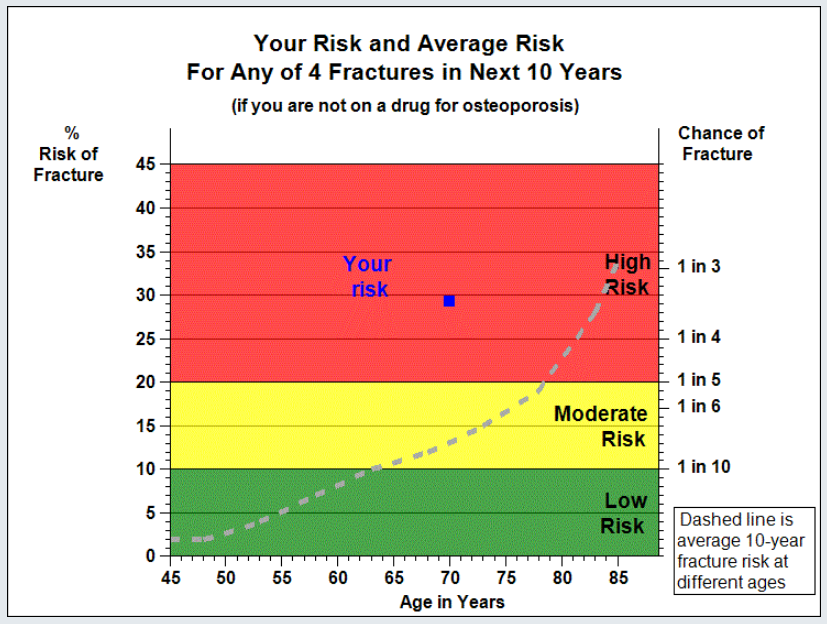
Even if all your other risk factors remain the same, fracture risk increases with age. The mix of fractures also changes with age: at 45–49 years, hip fractures account for only 7% but increase to 50% at 75 years. In contrast, the proportion of wrist fractures decreases with age, from 60% among the younger group to 26% among the older.
Fractures are often related to falls, and the risk of serious injury from a fall increases with age. There are many reasons older adults are susceptible to falls. These include side effects of some medications, loss of muscle mass and strength, declining balance, loss of agility, and vision impairments.
Keep in mind that your fracture risk score is not predictive for you. It is merely the average 10-year risk of someone with similar characteristics.
You can still use the calculator without your bone density number, but the results won’t be as accurate. Your results will be based on your body mass index and the fracture risk of a group of similar age, race, gender, and body mass.
The actual risk may be higher, especially for someone with a T-score in the osteoporosis or low bone density (osteopenia) range.
Ask your doctor for the complete report from your last DXA.
More information>> Answers to Frequently Asked Questions about the Calculator
There is certainly a strong genetic factor in determining whether you may get osteoporosis. In fact, family history is one of the main risk factors. The only way you can find out if you have osteoporosis is by having a bone density test.
Family history of hip fractures increases the risk of hip fractures for their children.
If you have a high fracture risk, that means you have at least a 20% chance of having a fracture (depending on your results). If you have a 20% chance of having a fracture, you also have an 80% chance of NOT having a fracture. In counseling patients about the risks and benefits of treatments for osteoporosis, we find that most individuals start to worry about their risk when it reaches “double digits,” and 20% (1 in 5) is usually of great concern.
Cost-effectiveness models and treatment guidelines that have been published based on U.S. costs and fracture rates cite high risk as 3% or more for 10-year risk of hip fracture and 20% or more for 10-year risk of any one of four fractures. These same percentage cut points are used to treat cardiovascular disease (National Cholesterol Education Program).
Here are the steps to speed your recovery and to reduce your risk of breaking another bone.
Weight-bearing exercises are best for bones. Impact on bones helps them adapt and become stronger. Weight-bearing activities can involve either body weight (from running) or gym weights. Activities can be either low impact or high impact.
Low-impact activities are less stressful on joints and already-fragile bones, but they still place more stress on the bones than non-weight-bearing activities. A good rule of thumb for low- impact activities is any activity that requires one foot on the ground at any given time. Low-impact activities include walking, step-aerobics, elliptical machines, step-climbing, elastic-band resistance training, and weight-lifting.
Low-impact activities can help reduce bone loss.
High-impact activities are most beneficial for people who want to build bone density and are not at risk of fracture. Participate in these activities sparingly to avoid overuse injuries of ligaments, tendons, and bones. It is important to incorporate active rest days in between high-impact activities. Active rest days should still involve other low-impact activities to let your body recover and to reap the benefits of a consistent exercise program.
More information>> Exercises for Building Healthy Bones
Seek professional advice from a teacher or therapist trained in “bone safe” osteoporosis exercise.
Tai chi is a better exercise than walking for fall prevention.
“Walking is kind of just keeping you in one plane moving forward, and it’s not doing any kind of postural training. What tai chi does is it gives you an increased area of postural stability, [which is] kind of your being able to remain upright in space.”
Many nutrients play a role in bone health. Calcium, vitamin D and magnesium are the key bone health nutrients that require special attention to ensure you meet your daily requirement.
Although many foods contain calcium, dairy products provide the most calcium per serving size. Daily requirements for calcium change with age. People who do not eat dairy foods will need to work hard to meet the recommended daily allowance or may need a calcium supplement.
The easiest way to get vitamin D is through exposure to sunlight — but we don’t recommend trying to go that route because of the risk of skin cancer. Talk to your doctor about adding a supplement.
Other nutrients for good bone health include: magnesium, phosphorus, potassium, and vitamin A.
The USDA recommends 0.36 grams of protein per pound of body weight, but current recommendations suggest that protein needs depend on age, body weight and activity level.
It’s best to get your calcium through your diet, but for many people this is not possible because they do not consume dairy products.
To meet the current Recommended Dietary Allowance (RDA) of calcium, women ages 18 to 50, and men ages 18 to 70 need 1, 000 milligrams (mg) of calcium. This equals two servings of a calcium-rich food, like dairy or foods and beverages fortified with calcium. Adults who eat cheese, yogurt, milk, and fortified beverages daily are likely getting sufficient calcium from their food and do not need a supplement.
As we age and hormone levels drop, we need more calcium to reduce bone loss that can lead to the risk of fractures. For women age 50+ and men age 70+, the RDA increases to 1,200 mg daily. Meeting this calcium requirement can be more challenging in older adults.
Only about 30% of women in the US get enough calcium from their diet alone.
Adults who may need supplements
Even if an adult gets sufficient calcium from their food, there are situations where the calcium may not be adequately absorbed in the body.
Take the kind of calcium you will take regularly! You will benefit from any kind of calcium, if you take it correctly, every day. Keep chewables in your car or on your desk. Put your tablets where you will remember to take them with meals. Calcium is a lifelong requirement, so choose a calcium supplement that is compatible with your lifestyle and one that you can afford.
There are a lot of pricey calcium supplements on the market that claim that they’re better than basic or generic products, but the evidence is thin to support the difference in cost.
Some calcium supplements may cause gas, bloating, and constipation in some people. If any of these symptoms occur, try spreading out the calcium dose throughout the day, taking the supplement with meals, or changing the supplement brand or calcium form you take.
If taken properly it doesn’t matter when you take calcium as long as you don’t exceed a dose of 600 mg. at a time and do take the supplement with something in your stomach. Food helps your stomach produce the acid needed to break calcium down for absorption.
More information>> Get the Best Out of Your Calcium Supplement
More information>> Guidelines for Calcium and Vitamin D Supplements
Proton pump inhibitors (PPIs) are a type of medicine that reduces stomach acids. They are usually prescribed because a patient’s stomach acid levels are too high, and the medication reduces the acids to a more normal level. You might consider calcium citrate rather than calcium carbonate if you are on these drugs because calcium citrate does not require stomach acid to break it down.
Calcium carbonate may cause acid rebound where the stomach overcompensates for the high dose of calcium carbonate, which is alkaline, by churning out more acid.
More Information>> Problems with Calcium Supplements
More Information>> Medications That Can Be Bad for Your Bones
Doctors are discovering more and more individuals with these types of gastrointestinal issues that affect calcium absorption. If you have absorption issues, you must maximize your calcium citrate and vitamin D intake. Talk to your doctor about the most absorbable form of calcium for you. Calcium citrate is considered to be a more absorbable form of calcium, and it can be taken with or without food. It is also generally more expensive.
Getting too much calcium from foods is rare. Excess intakes are more likely to be caused by the use of calcium supplements.
High calcium intake can cause constipation. It might also interfere with the absorption of iron and zinc. High intake of calcium from supplements, but not foods, has been associated with increased risk of kidney stones. Some studies also link high calcium intake, particularly from supplements, with increased risk of cardiovascular disease.
It’s best to get your calcium through your diet, rather than supplements.
More information>> Guidelines for Calcium and Vitamin D Supplements
Most kidney stones are formed when oxalate, which is naturally found in many foods, binds to calcium while urine is produced by the kidneys. Calcium, however, is not the main culprit in calcium-oxalate kidney stones. A diet that is low in calcium actually increases the risk of such kidney stones.
If you are worried about kidney stones, instead of reducing calcium, cut back on salt and pair oxalate-rich foods (examples: peanuts, rhubarb, spinach, beets, chocolate and sweet potatoes) with calcium-rich foods. One of the best ways to avoid kidney stones is to drink plenty of water.
Calcium supplements generally are not the cause of kidney stones; however, if you have had kidney stones, it would be wise to check with your doctor about what kind of calcium to take and what foods to limit in your diet.”
Magnesium is needed for good bone health; however, many of our foods are rich in magnesium, so supplementing it in modest quantities is not essential but will do no harm. It is important to recognize that loop diuretics such as furosemide (Lasix) can deplete the body of magnesium if magnesium is not supplemented.
Sometimes people will get constipated from calcium because of its mild binding effect. .Adding a bit of magnesium can help. Some people buy a calcium supplement with magnesium for that reason.
All osteoporosis treatment plans must include calcium and vitamin D. Some medications are now formulated to include calcium. Check with your doctor to make sure you are getting the right amount of calcium and vitamin D.
Green vegetables like spinach and broccoli are very good for you, but are not the best source of calcium. Those vegetables contain phytic and oxalic acids that bind with the calcium and make it less bioavailable. This means that the body is not able to absorb the calcium. Additionally, these high fiber vegetables move through the body quickly and reduce the ability of the body to extract the calcium.
Calcium bioavailability varies from food to food. Foods that are high in oxalates like spinach, rhubarb, sweet potatoes, and dried beans are poorly absorbed. But there are still a number of good calcium sources outside of milk.
Current science suggests that the RDA of vitamin D 5 – 10 mcg (200 – 400 IUs) is too low and these levels are under review by the Institutes of Medicine. American Bone Health recommends 25 – 50 mcg (1,000 – 2,000 IUs) daily. Most calcium supplements do not have enough vitamin D and multivitamins contain very little. The combination of vitamin D from all sources should be 25 – 50 mcg (1,000 – 2,000 IUs) daily.
Many doctors are using 1,250 mcg (50,000 IUs) once a month in their patients who are deficient. There are reported cases of vitamin D intoxication causing hypercalcemia and renal failure at extremely high daily doses exceeding 1,250 mcg (50,000 IUs) taken for protracted periods of time.
You can take Vitamin D at any time of day with or without food.
More information>> Guidelines for Calcium and Vitamin D Supplements
There are a number of good reasons to supplement vitamin D. If you are using sunscreen, it screens out the UV rays that convert precursors of vitamin D to vitamin D in your skin. People with darker skin do not process vitamin D as well as those with lighter skin. People, especially older adults, are not generally out in the sun on a regular basis.
In northern latitudes for much of the year, vitamin D is screened out by the atmosphere due to the low angle of the sun. And as we get older, our skin does not process vitamin D as well as it does when we are younger. The skin also becomes less efficient at producing the vitamin from sunlight as we age. Vitamin D is being shown to have a beneficial effect on many body functions and is safe at the recommended 25 –50 mcg (1,000–2,000 IUs) per day and not expensive to supplement.
Maybe. Osteoporosis is a diagnosis you get from a bone density test. This test result is one piece of information to consider. To weigh the pros and cons of taking a medicine to prevent fractures and bone loss depends on your risk of breaking a bone. Your next step is to know your fracture risk.
However:
 Everyone should take steps to lower fracture risk, including reducing fall risk, being active, having an optimal vitamin D level, and getting adequate nutrition including protein, magnesium, and 1,000–1,200 mg of calcium a day from each combination of food and supplements.
There are a number of good options. All of the osteoporosis treatments are FDA-approved and have been shown to significantly reduce the risk of fractures.
Finding the treatment that is right for you will be based on how high your fracture risk is and what form of treatment is most convenient for you. There are pills, injections and infusions.
All of the medicines have good safety data and only act on the bones. Some have minor side effects, but in general, the risk of starting a treatment may be much less than the risk of having another fracture.
All of these treatments require a prescription from a doctor.
Download a quick guide to osteoporosis medicines
Antiresorptive medicines improve bone strength by normalizing bone turnover.
Anabolic medicines increase bone formation
Women who have been on the osteoporosis medicines called bisphosphonates for 3 to 5 years should get a repeat bone density test and fracture risk assessment. Women who have a low-to-moderate risk of fracture could be prescribed a “bisphosphonate holiday.”
During a “drug holiday” the patient’s fracture risk is regularly assessed and treatment resumed accordingly. A “drug holiday” should be considered a short-term vacation, not long-term retirement.
The advice about a “drug holiday” applies only to bisphosphonates.
Other osteoporosis medicines such as denosumab (Prolia®), teriparatide (Forteo®), abaloparatide (Tymlos®) and romosozumab (Evenity®) must be followed by another medicine.
In the case of teriparatide and abaloparatide, using a bisphosphonate or denosumab will help maintain the gains in bone density made by the two bone building medicines.
When medicines like denosumab and romosozumab are stopped, the metabolic process that they were inhibiting resumes and there can be rapid bone loss.
Do not stop any medicine for osteoporosis before you talk with your health care provider.
All medicines have side effects. It’s important to distinguish between minor side effects and very serious but rare adverse effects. Mild side effects may disappear as your body becomes accustomed to the new medicine. Others can be managed by your doctor adjusting the dosage, timing, or even the drug prescribed.
Rare harms can occur with long-term use of some osteoporosis medicines. The risk of harm appears to increase the longer a patient stays on the medicine, particularly after 4 to 5 years.
All of the osteoporosis medicines are FDA approved for the treatment of osteoporosis. The medicines have gone through rigorous studies, have good safety data and they all reduce the risk of fractures by at least 35%. Using the ABH Fracture Risk Calculator™ can help you weigh the risks of a fracture against the risks of the medicines.
Taking a medicine for any health issue is a choice. It is important to weigh the risks and the benefits. If you are at high risk of having a fracture, you will benefit from a medicine.
All medications can have side effects. By comparison, osteoporosis medicines are relatively safe and only target the bones—no other organ systems.
The rare side effects from bisphosphonates and denosumab are rare. The risk of an adverse event is very low (in the range of 1:20,000 to 1:100,000). By comparison, the risk of an osteoporosis fracture for a woman over age 50 is 1:2.
From our friends at the Kaiser Healthy Bones program, here is another way to think about it. Out of 1,000 people on a bisphosphonates or denosumab for 5 years:
There is so much information in the media and on the internet that can be marketed as the cure for any number of things. Always ask for the scientific evidence behind the claims. This science should be published in a peer-reviewed journal, meaning that it has been vetted by experts for the scientific method and analysis of the data.
Remember, there are also side effects to not taking the osteoporosis medications—fracture, disability, and possibly death.
Herbal or natural supplements, also call nutraceuticals, are not regulated by the FDA. Manufacturers of nutraceuticals have not been required to show that they are safe and effective. Additionally, it is difficult to know how much of any ingredient you may be getting in many herbal or natural remedies. Studies are required to determine if there is sufficient evidence to recommend these supplements.
There is insufficient data and no evidence-based guidelines on vibration platforms, so American Bone Health does not endorse the use of vibration platforms for improving bone health at this time.