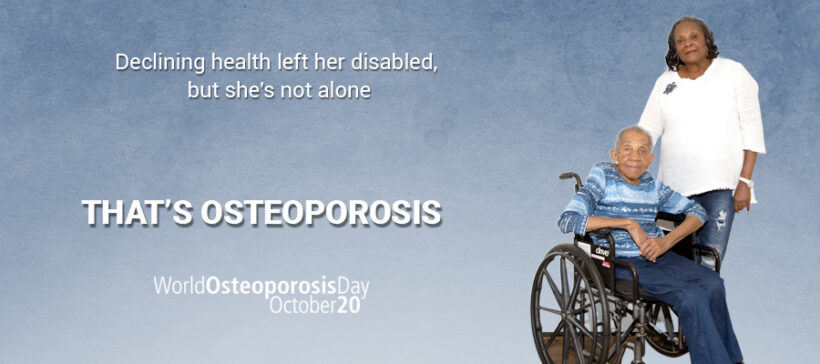
World Osteoporosis Day (WOD), on October 20 each year, marks a year-long campaign dedicated to raising global awareness of the prevention, diagnosis and treatment of osteoporosis. WOD aims to make osteoporosis and fracture prevention a global health priority by reaching out to health-care professionals, the media, policymakers, patients, and the public at large. The campaign will feature “THAT’S OSTEOPOROSIS” as a headline, highlighting emotionally impactful visuals and stories of real people living with osteoporosis in all regions of the world.
The campaign will emphasize the direct link between osteoporosis (the silent, underlying disease) and broken bones, which have a serious, life-changing impact in terms of pain, disability and lost independence. It will also focus on osteoporosis as a ‘family affair’, with family caregivers often carrying the burden of care, and the disease affecting multiple generations of the family.
Augustine Shorten
Like many people in her family, Augustine Shorten, a proud African American woman from Lake Charles, Louisiana, has been blessed with a long life. She just turned 97.
Also like many people in her family, Augustine has bone and joint problems. Her gnarled right knee shows the signs of osteoarthritis, which she has endured for decades of sometimes-debilitating pain.
“I think it had to be from my grandfather’s side because he had the same issues that my mother had with the knee caving in,” says Augustine’s daughter and caregiver, Linda Shorten, 65. Linda has had both of her knees surgically replaced. “We knew it was from him, and then we watched the same thing happen to her, and all of us have had some kind of knee problems. All of us.”
Augustine also has suffered from broken bones caused by osteoporosis.
“Many people believe that the Black community does not have to worry about bone health issues,” says Nicole Wright, 38, Augustine’s granddaughter, who happens to study osteoporosis epidemiology and racial disparities in osteoporosis management and outcomes. “The skeletal system is an organ that needs to be cared for just like any other organ; when it is not, problems can arise in any racial or ethnic group.”
Key messages of World Osteoporosis Day 2020
- Osteoporosis is the underlying cause of painful, debilitating and life-threatening broken bones – known as fragility fractures.
- Osteoporosis is a growing global problem: worldwide, fractures affect one in three women and one in five men over the age of 50.
- Osteoporosis affects families – family members often bear the burden of care
- If one of your parents had osteoporosis or hip fracture, this may increase your own risk of developing the disease. Take the American Bone Health Fracture Risk Calculator™ to identify your risk factors.
- At risk? Be sure to request a bone health assessment – take early action for prevention!
- Bone health concerns the entire family – ensure your family maintains a bone healthy lifestyle.
- Advocate! Call on healthcare providers to close the massive ‘care gap’ which leaves many patients unprotected against a cycle of disabling fractures.
Posted: 10/11/20
As a service to our readers, American Bone Health provides access to our library of archived content. Please note the date of the last review on all articles. No content on this site, regardless of date, should ever be used as a substitute for direct medical advice from your doctor or other qualified clinician.