 In recognition of National Minority Health Month, American Bone Health wants to you know about differences and disparities in bone health that affect certain racial and ethnic minority groups.
These quick facts are drawn from existing articles on the American Bone Health website as well as research published and reported elsewhere. Special thanks to Dr. Nicole C. Wright, an osteoporosis researcher at the University of Alabama-Birmingham, for sharing slides she prepared for a presentation on this topic in 2018.
- Prevalence of osteoporosis and low bone mass (osteopenia) varies among racial and ethnic groups in the United States. Among white Americans, 9 percent have osteoporosis and 42.9 percent have low bone mass. Among Mexican Americans, 13.1 percent have osteoporosis and 42.2 percent have low bone mass. Among black Americans, 4.2 percent have osteoporosis and 29.7 percent have low bone mass.
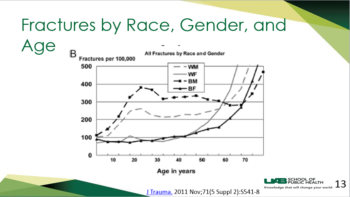
- African Americans have a lower risk of breaking a bone in their lifetime, compared to white Americans and other ethnic groups. However, fracture risk may be rising among this population because of other chronic conditions, and fractures increase dramatically after age 75.
- Chinese people have lower average bone mineral density than most other racial groups, but Chinese women have lower rates of spine fractures than white women and much lower rates of hip fractures than white women. This seems to be due to differences in hip geometry and bone microarchitecture.
- A study conducted in 2005 in Southern California found that Latina women had the highest risk of fractures compared with Native Americans, African Americans and Asian Americans.
 Evidence gathered by American Bone Health found that Latinos are not as likely as other as other ethnic groups to take recommended prevention steps to protect themselves from bone loss, osteoporosis and fractures.
- Black women are less likely to receive medicine to treat osteoporosis and prevent fractures. Only 8.4% of black women received meds vs 13.6% of high-risk women in one study. And black women were 18% less likely to receive medicine following a fracture compared to whites.
- Black women are also less likely to be screened for osteoporosis compared with white women.
 Evidence gathered by American Bone Health found that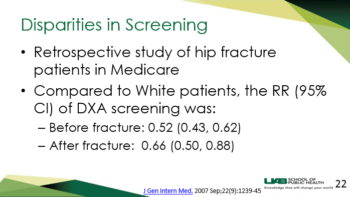
- Because of differences in genetics, African Americans may not require as much calcium and vitamin D to maintain good bone health as other ethnic groups.
- Lactose intolerance is common among members of minority groups in the United States, especially African Americans, Asian Americans, Mexican Americans and Native Americans. People who are lactose intolerant are at risk of not getting enough calcium in their diet to maintain strong bones.
- Black women have less knowledge about osteoporosis than white women. Addressing disparities requires greater education and awareness among both patients and providers.