
 Your first job is to control pain and inflammation around the fracture. Your doctor may recommend an over-the-counter pain reliever, such as acetaminophen (Tylenol) or ibuprofen (Advil, Motrin IB) or a combination of the two.
You can reduce the inflammation and pain by applying ice and by keeping the broken bone elevated above the level of your heart on a pillow when you sit or lie down during the first 1 to 2 weeks after your injury.
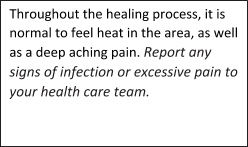
Throughout the healing process, it is normal to feel heat in the area, as well as a deep aching pain. Report any signs of infection or excessive pain to your health care team.
Make your home safe and easy to get around
When you first arrive home after a broken bone, you will be highly aware of the hazards in your home that you have to navigate. You will need a secure space to heal. Ask a friend or family member to help you by removing clutter, throw rugs and extension cords, and by installing handrails, nightlights and grab bars. Situate everything you need nearby. An occupational therapist can visit your home to give you extra tips and advice.
Review this safety checklist
Throughout the house:
- Remove from walkways any items that you can trip over.
- Keep items you use often (TV remote, phone, eyeglasses) on a table near you.
- Add nightlights in hallways and in the bathroom.
- Remove or secure small throw rugs.
In the bathroom:
- Put grab bars next to your toilet and in the tub or shower.
- Use non-slip mats in the bathtub and on shower floors.
- Consider a shower seat and a raised toilet seat if you had a leg or hip fracture.
In the bedroom:
- Keep items you use regularly on a table next to the bed with a lamp.
- Keep electrical and telephone cords pushed back against the wall.
- Keep the floors free of clothes, books, shoes and other clutter.
Outside the house:
- Keep a safe path from your home to the street.
- Remove ice from steps and walkways.
- Install handrails on steps.
 Get bone-healthy nutrition
 Get bone-healthy nutrition
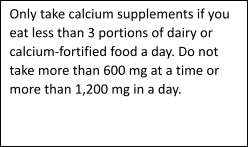
 As your bone is healing, you will need extra calcium to help mineralize the bone and vitamin D to help with calcium absorption. Aim for 3–4 servings of a dairy food or other high-calcium food, and take 25–50 mcg (1,000–2,000 IU) of vitamin D every day.
Protein is essential for keeping muscles and bones strong. Aim to get 4–6 ounces of meat, poultry or fish or other high-protein foods each day.
Follow-up Appointments to Assess Your Function and Bone Health
As your fracture heals, you will work with your health care team to assess your bone health and take steps to prevent another fracture. Get to know the players.
Orthopedic surgeon stabilizes your fracture to help the bone heal and may have prescribed pain medicine and occupational therapy. In the coming weeks, the surgeon will order X-rays to monitor how your fracture is healing. Once the bone is healed and any cast is removed, the surgeon will prescribe physical therapy.
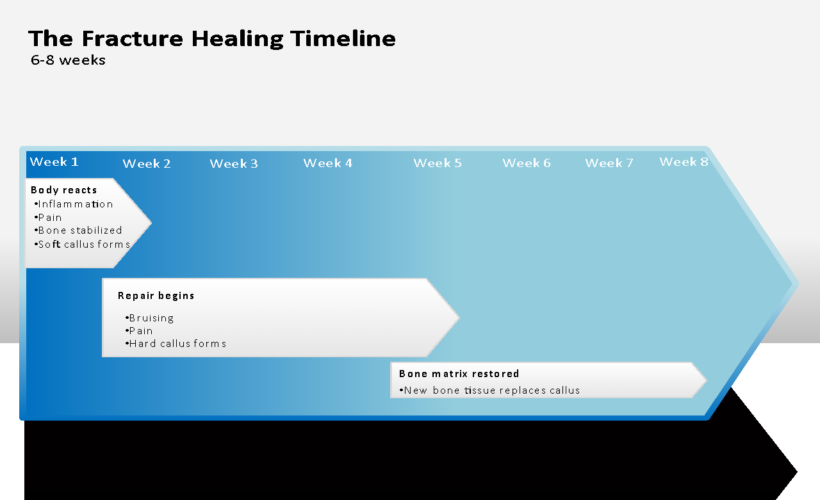
Ortho timeline
- If you had a cast or no surgery, expect a follow-up appointment 6–8 weeks after your fracture occurred.
- If you had surgery to repair the bone, expect a follow- up 1–2 weeks after surgery and periodically until the bone heals.
Occupational therapist (OT) assesses how well you can do typical daily activities, like bathing and dressing. The therapist may visit your home to help you return to your normal routine.
Physical therapist (PT) evaluates how much function you lost while the fracture was healing and you weren’t using your muscles. They will create a rehabilitation plan to strengthen muscles, increase flexibility, and improve balance and joint movement.
The goal of physical therapy is to safely bring back full movement in your joints around the fracture and to build strength while the healing continues. You may start physical therapy right away after a hip fracture or once your cast is removed for other types of fractures.
PT Timeline
- Expect 6–8 weeks for the bone to heal before you begin physical therapy.
Bone density technician performs a bone mineral density test (DXA) to measure the strength of your bones to see if you are at risk for another fracture. The machine uses a small amount of X-rays to measure the amount of mineral—namely calcium—in your bones. Your health care provider will need to refer you for this test. The test is simple and painless and takes less than 15 minutes. If you wear loose-fitting clothes, you will not have to change.
The DXA gives you a T-score and a risk score that is used to assess your chance of breaking another bone. The T-score compares your bone density to that of a healthy young adult. But that is only part of the story. Your doctor or osteoporosis specialist will look at other factors that could affect the strength of your bones.
Bone Density Test Timeline
- Schedule an appointment for 3 months after your fracture, and ask for a copy of the test results and scan images to share with your provider.
Your health care provider (HCP) monitors your bone health after your fracture heals. The provider will review the results of your bone density test, evaluate your risk of breaking another bone and work with you on a plan to prevent future fractures. The plan may include nutrition, physical activity, fall prevention instructions, and a medication to strengthen your bones. Ask your HCP if any of your medications might increase your risk of falling.
HCP Timeline
- See your provider after your bone density test to make a bone health plan.
An osteoporosis specialist may be helpful if you have a complicated medical situation that could be affecting your bone health. Your HCP may refer you to an endocrinologist or rheumatologist to do a further assessment.
A pharmacist is a great resource for answering questions about assistive devices, supplements and medications. Bring all of your medications to the pharmacy during a quiet time of the day and review these questions with the pharmacist:
- Am I taking my medications the right way?
- Am I taking the right dose at the right time?
- Should any of my medications or supplements not be taken at the same time?
Create your bone health plan
Understand fracture risk
Once you have completed all of your follow-up appointments, you will have almost all of the components of your bone health plan. These may include nutrition, physical activity, fall prevention instructions, and a medication to strengthen your bones. Now that you have had a broken bone, the chance of having another is nearly doubled. In fact, of all future fractures, about 1-in-4 will occur in the first 12 months.
Advanced age, gender, family history, serious chronic conditions and use of certain medications may increase your risk of breaking a bone whether or not you have low bone density. Your HCP will assess these risk factors to determine your risk of breaking another bone in the next 10 years. If you are at moderate or high risk, your HCP will talk with you about taking a medicine to strengthen your bones.
Medicines to strengthen bones
 Medicines to strengthen bones
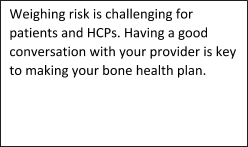
 All FDA-approved treatments used to strengthen bones go through rigorous testing to determine effectiveness and safety. If your risk of having another broken bone is high, you will benefit from a bone drug. Before you begin any bone drug, your HCP or osteoporosis specialist may order lab tests to determine if there is any reason for your bone loss. The most common tests measure your vitamin D blood level and calcium absorption.
 Finding a bone medicine that is right for you is based on your fracture risk and your personal preference. There are many options available to reduce your risk. As with any medication, some people can experience side effects. Discuss the risks with your HCP or specialist and be sure to take the bone drug as prescribed. You will need to get enough calcium and vitamin D for the drugs to work. Your HCP will review your progress with you regularly.
Build Strength and Get Moving Again
Physical activity stimulates bone building, strengthens muscles and improves balance. Follow the plan from your physical therapist and get one of your family members or friends to work with you to make it fun.  Focus on exercise that:
- Strengthens lower legs
- Improves balance
- Enhances posture
Modified squats strengthen lower legs and help you get up out of a chair.
- Stand with feet hip width apart.
- Keeping back straight, squat down by hinging forward at the hip and sticking your rear-end out.
- Lower your body as far as comfortable while keeping your knees behind your toes.
- Hold this squat position for 1 second.
- Return to standing.
- Repeat 8 times.
Standing on one leg improves balance.
- Use a chair or table to steady yourself when you start.
- Stand tall. Lift your knee until your thigh is parallel to the ground.
- Hold for 30 seconds. Slowly lower your leg.
- Repeat with other leg and work up to balancing without holding on
Standing “W” enhances posture.
- Stand with your feet hip width apart.
- Begin with arms at shoulder level, elbows bent and fingers pointing up.
- Squeeze shoulder blades together, pressing your arms back and down.
- Hold for 3 seconds.
- Repeat 8 times.
Preventing falls is a key to not breaking bones. Use these tips to stay on your feet.
Pay attention to where you put your feet
- Slow down and watch where you walk.
- Avoid carrying items in front of you that keep you from seeing where you are stepping.
- Use handrails.
Stay on the ground
- Ask for help if you need to use a stool or ladder
Check your footwear
- Wear shoes that have good soles and provide support.
- A shoe with a low heel is ideal.
- Avoid slippers and flip flops.
- Don’t wear sandals without a heel strap.
Get your eyes checked every year
- Good eye sight can reduce your chances of falling.
- Update your eyeglasses.
- Have your eye doctor check for glaucoma or cataracts.
Review your medications with your HCP or pharmacist
- People who take four or more medications are at increased risk of falling.
- Some medications can cause dizziness and sleepiness.
- Know your medication side effects so you can take extra precautions to prevent falls